[Edaily, Reporter Song Young-doo] “What is demanded first and foremost in the patient monitoring market is whether the solution can actually be used in emergency situations. This is close to an entry requirement for hospitals, especially tertiary hospitals. The next stage is how many vital signs can be integrated and managed in real time, which becomes the standard for market expansion. Ultimately, companies that possess these two core competitive advantages will reshape the market.”
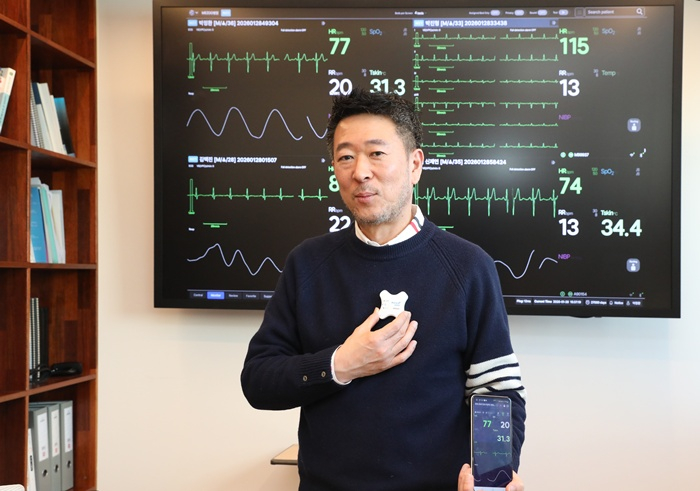
Meeting with Edaily at Mezoo’s R&D Center in Wonju, Gangwon Province, on the 28th, CEO Park expressed confidence that the domestic patient monitoring market is facing another structural inflection point, and that Mezoo will be at the center of it.
Park said, “In the past, hospitals first asked, ‘Why should we use this?’ Now they ask, ‘How much revenue does this generate if we use it?’” He added, “This means patient monitoring has moved beyond the stage of technological experimentation and into the realm of business.” He emphasized, “We have now entered a phase where competition is not about who entered the market first, but about which technologies can expand how far.”
Mezoo is preparing for a KOSDAQ listing under the technology-special track. It recently submitted its securities registration statement and is being evaluated as a company capable of competing head-on with Seers in the patient monitoring market.
In terms of patient monitoring technology and product development alone, Mezoo is one of the earliest starters in Korea. Park explained, “We began thinking about the concept of ambulatory remote patient monitoring at a very early stage, and even carried out on-site validation through a regulatory sandbox project.” In a pilot project conducted with hikers in the Gangwon Digital Healthcare Regulatory Free Zone, remote monitoring led to the discovery of previously unrecognized arrhythmia patients.
Despite this, Mezoo entered the market later than Seers. Park attributed the reason not to technology, but to institutional and market conditions. He said, “At the time, remote monitoring itself was not institutionally permitted, and after the COVID-19 period, hospital revenue structures deteriorated sharply,” adding, “Hospitals were in a situation where they had almost no capacity to introduce new equipment.” In other words, the technology was ready, but the market had not yet opened.
What changed the situation was the reimbursement strategy proposed by Seers. Seers rapidly expanded the domestic patient monitoring market by installing equipment in hospitals first and then sharing the reimbursement revenue generated afterward. Park noted, “Through this model, hospitals were able to confirm that it actually generates revenue,” and added, “Once the market began to open, the approach changed completely.”
Mezoo is now operating a reimbursement-sharing model using the same reimbursement codes as Seers. Park explained, “From the hospital’s perspective, this allows them to generate additional revenue without an initial adoption cost, and from the company’s perspective, revenue naturally grows as the number of beds increases,” adding, “It has already been proven that this model works in Korea.”
On top of this, the addition of Dong-A ST’s sales and marketing capabilities is accelerating the pace of bed adoption. Park said, “In medical devices, how deeply you understand the hospital field ultimately matters,” adding, “Dong-A ST has extensive sales networks and experience across tertiary and general hospitals.” He continued, “As Mezoo’s technology and product competitiveness combine with Dong-A ST’s sales power, the speed and depth of hospital adoption discussions have changed.”
However, Park clearly distinguished Mezoo’s technological starting point. He stated firmly, “Mezoo is not a company that started from what is commonly called a ‘Holter.’” A Holter is a device used for post-hoc diagnosis, recording ECG data over a set period and analyzing it after the test is completed. Its focus is on recording and analysis, not real-time surveillance or immediate response.
Park explained, “A Holter is an examination device, while what we make is a patient monitoring device,” adding, “They may look similar on the surface, but their roles in clinical settings are completely different.” He further said, “A Holter is equipment that collects data to be reviewed later, whereas a patient monitoring device is meant to see what is happening to the patient at this very moment and respond immediately.”
This difference becomes especially clear in emergency environments. Mezoo’s flagship product, HiCardi, has been designed and validated for use even in defibrillator (AED) shock environments, and has secured the necessary regulatory approvals as a patient monitoring device. It can be applied not only in general wards but also in emergency departments and intensive care units. Park said, “Even if it looks like a similar patch, whether it can actually be used on emergency patients is an entirely different issue,” adding, “If you do not meet this standard, it is difficult to enter tertiary hospitals.”
source : https://www.edaily.co.kr/News/Read?newsId=02889686645346584&mediaCodeNo=257
